




CRYAB (Alpha B Crystallin) mouse monoclonal antibody, clone OTI5C9 (formerly 5C9)
Applications & Recommended Dilution
Applications & DilutionRecommended Dilution- Reactivity
- Human / Mouse / Rat
- Assay
- IF
- Reactivity
- Human / Mouse / Rat
- Assay
- IHC
- Reactivity
- Human / Mouse / Rat
- Assay
- IP
- Reactivity
- Human / Mouse / Rat
- Assay
- WB
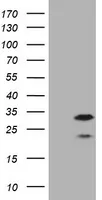
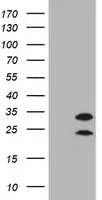
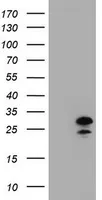
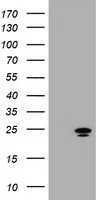
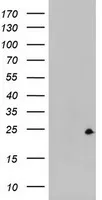
Product Images
Product ImagesImages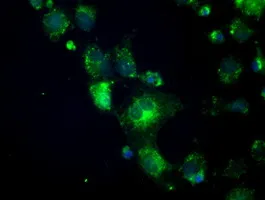
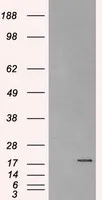
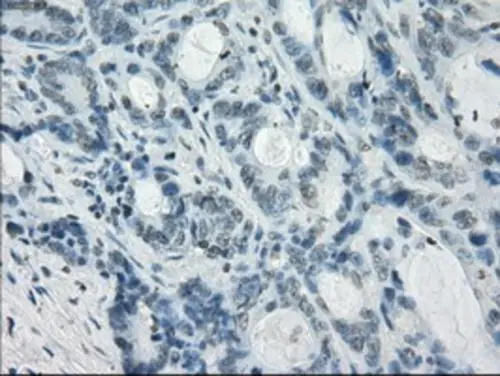
Product Specifications
SpecificationsProduct Specifications- Species Reactivity
- HumanMouseRat
- Applications
- IFIHCIPWB
- Clone name
- OTI5C9
- Calculated molecular weight
- 20 kDa
- Immunogen
- Full length human recombinant protein of human CRYAB (NP_001876) produced in HEK293T cell.
- Isotype
- IgG1
- Host species
- Mouse
- Clonality
- Monoclonal
- Purification method
- Affinity Purification
- Uniprot-A
- P02511
- WB
- 1:500
- IHC
- 1:50
- Shipping
- They are shipped out with dry ice/blue ice unless customers require otherwise
- Storage Condition
- Store at -20°C PBS (pH 7.3) containing 1% BSA, 50% glycerol and 0.02% sodium azide.Stable for 12 months from date of receipt.
- Formulation
- Liquid
- Storage Buffer
- PBS (pH 7.3) containing 1% BSA, 50% glycerol and 0.02% sodium azide.
Crystallins are separated into two classes: taxon-specific, or enzyme, and ubiquitous. The latter class constitutes the major proteins of vertebrate eye lens and maintains the transparency and refractive index of the lens. Since lens central fiber cells lose their nuclei during development, these crystallins are made and then retained throughout life, making them extremely stable proteins. Mammalian lens crystallins are divided into alpha, beta, and gamma families; beta and gamma crystallins are also considered as a superfamily. Alpha and beta families are further divided into acidic and basic groups. Seven protein regions exist in crystallins: four homologous motifs, a connecting peptide, and N- and C-terminal extensions. Alpha crystallins are composed of two gene products: alpha-A and alpha-B, for acidic and basic, respectively. Alpha crystallins can be induced by heat shock and are members of the small heat shock protein (sHSP also known as the HSP20) family. They act as molecular chaperones although they do not renature proteins and release them in the fashion of a true chaperone; instead they hold them in large soluble aggregates. Post-translational modifications decrease the ability to chaperone. These heterogeneous aggregates consist of 30-40 subunits; the alpha-A and alpha-B subunits have a 3:1 ratio, respectively. Two additional functions of alpha crystallins are an autokinase activity and participation in the intracellular architecture. Alpha-A and alpha-B gene products are differentially expressed; alpha-A is preferentially restricted to the lens and alpha-B is expressed widely in many tissues and organs. Elevated expression of alpha-B crystallin occurs in many neurological diseases; a missense mutation cosegregated in a family with a desmin-related myopathy. [provided by RefSeq]
Storage & Shipping
Storage & ShippingHandling01Shipping
They are shipped out with dry ice/blue ice unless customers require otherwise
02Storage Condition
Store at -20°C PBS (pH 7.3) containing 1% BSA, 50% glycerol and 0.02% sodium azide.Stable for 12 months from date of receipt.
03Formulation
Liquid
04Storage Buffer
PBS (pH 7.3) containing 1% BSA, 50% glycerol and 0.02% sodium azide.
Related Products
Related ProductsRelated

Follow Us on WeChat

 WhatsApp

Scan to contact us via WhatsApp
